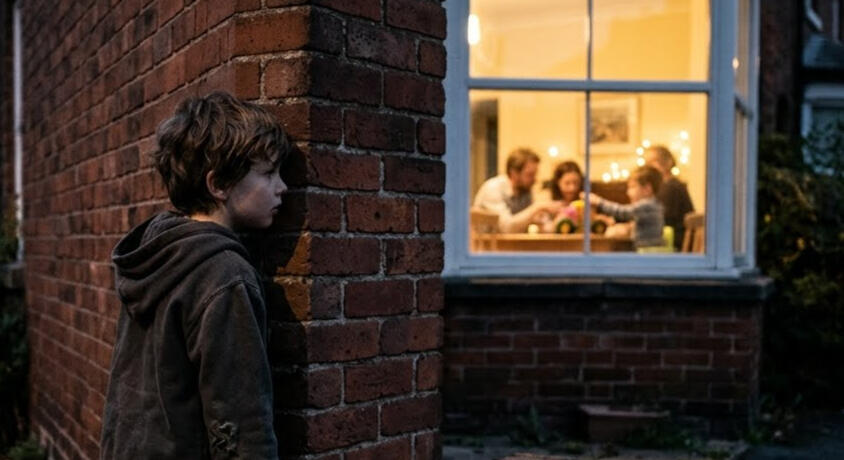
Uncurtained Windows
A Riveting Autobiographical Novel:
The boy in tattered clothes could only look through the glass at a warmth he didn't possess. He would spend decades running through homelessness, military service, and incarceration before realizing that the light he was looking for had already found him. Discover a journey defined not just by survival, but by grace in the midst of it all.
As an Amazon Associate, I earn from qualifying purchases.
-OCTOBER 6 2026-
Prologue — Shards Of Memory
Memories do not come in order. They arrive like broken glass, shards scattered across the floor of his mind, sharp and shining, each reflecting a different moment of his past. Some belong to childhood, others to years when he is grown, but together they tell one story. His story.
So if the telling seems uneven, if the boy appears first under a bridge and then peering through a window, if he is beaten in one memory and laughing in another, it is not confusion. It is truth. For memory is not neat. It does not follow the rules of time. It spills and overlaps, weaving pain and hope together until they are one.
The story begins in Modesto, California, on the banks of the Tuolumne River, under the Lions Street bridge. He could not have told you his age then, and even now the number will not come. No birthday marked a before and after, no year he could point to and say, this is when it started. As far back as memory reaches, this was simply what a childhood was.
He didn't have a house. He survived on what scraps the world threw away, eating from dumpsters, sleeping beside them, washing in the filthy water of the river that carried the city's trash downstream past the bridge that was, for a time, the closest thing he had to an address. This was life for the boy—a life of shadows, where comfort was a stranger and hunger a constant companion.
He often felt like one of the lost boys, a Peter Pan character without a Neverland to escape to. While other children dreamed of flying, he wandered the streets at night, staring through windows left uncurtained. Inside, he saw warmth: families gathered around tables, eating, laughing, loving. He longed for it with an ache too deep to describe, but it was never his to enter—only his to witness from the outside.
His name was seldom spoken. When it was, it came gently from his sister—three years younger, the one bright light in his dark world—or harshly from his parents when they weren't lost in the fog of their addiction. Heroin ruled the household. When they were high, at least, there was a strange and fragile calm—thin, brittle, but quiet. It was far more peaceful for them to be lost in their haze than clawing after their next fix. The craving made them agitated, sharp-edged, dangerous in a way the high never was.
He remembered one night more clearly than the rest, though he could not have said which night it was among so many that looked the same. His sister was hungry, and she was crying about it the way small children cry—without calculation, without knowing yet that the sound of her own hunger was dangerous. Their parents were deep in the ache of craving, the kind that made the air in whatever room they were sharing feel thin. He knew, even then, small as he was, what her crying would cost her if it reached them first. So he made noise of his own—enough to turn the anger toward himself instead. It worked, the way it usually worked. He took the hit meant to silence her. His back, his arms, his young body carried the bruises that might have scarred her instead.
As far back as he could remember, he was homeless. Some nights he stayed in shelters, surrounded by strangers who smelled of desperation and fear. Other nights, he found temporary refuge in the homes of other addicts—people who were kind enough in their own chaos to let him stay until they and his parents ran out of drugs and it was time to move on again. Sometimes those same borrowed addresses were the ones that got him into a school building for a season, until the family that lent it moved on, or he did, and he simply stopped showing up. No one asked why. No one, it seemed, kept track closely enough to notice.
Home, as he knew it, was not a place. It was a state of constant uncertainty, a rhythm of moving from one temporary roof to another, always wondering if the next day would bring safety, or yet another storm. Yet even in that instability, he carried a stubborn spark—an instinct to survive, to protect his sister, and to somehow hold onto himself in a world determined to tear him apart.
He must remember this—not to relive the fear, but to honor the resilience he built in those years, and to never forget the love that burned in him even then. For even as a boy, unwanted and unseen, he loved his sister enough to become her shield. That love was proof that even in a world of brokenness, something pure still lived within him.